So, What is Agentic AI?
Your RAG system answers questions. But what if it could solve problems? Learn how agentic AI transforms retrieval from Q&A into goal-directed systems that plan, act, and iterate.

You ask an AI to help you understand why users are churning.
A traditional chatbot searches your docs and says: "Here's our documentation on user retention metrics."
An agentic AI does something different. It queries your analytics database, identifies the three features with highest drop-off rates, cross-references support tickets mentioning those features, drafts a summary with specific recommendations, and asks if you want it to create Jira tickets for the top issues.
That's the difference between answering questions and accomplishing goals.
What Makes an AI "Agentic"?
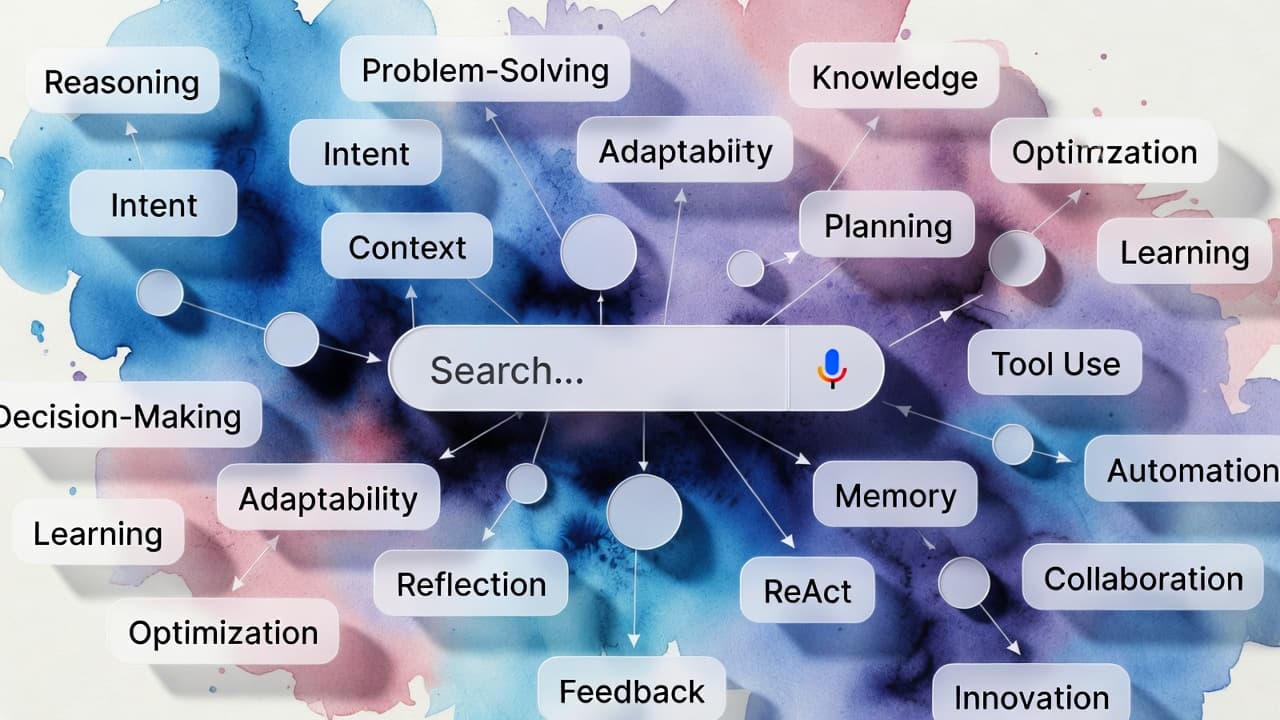
The term "agentic" describes AI systems that can take autonomous actions toward objectives. Instead of a single query → response pattern, agentic AI operates in loops: observe, plan, act, evaluate, repeat.
The Five Capabilities of Agentic AI
Capability | What It Means | Example |
|---|---|---|
Tool Use | Interacting with external systems | Calling APIs, running code, searching databases |
Multi-step Reasoning | Breaking complex goals into subtasks | "To answer this, I first need X, then Y, then Z" |
State Management | Remembering context across actions | Tracking what's been tried, what worked, what failed |
Self-Correction | Recognizing and recovering from errors | "That search returned nothing useful—let me try different keywords" |
Goal-Directed Behavior | Pursuing objectives autonomously | Working toward an outcome without step-by-step instructions |
Claude Opus 4.5 from Anthropic demonstrates these capabilities at a level that makes production agentic systems practical.
Its performance on two key benchmarks tells the story.
The Benchmarks That Matter : Claude Opus 4.5
SWE-bench: Can AI Actually Fix Bugs?
SWE-bench tests whether AI can fix real bugs in real codebases. Not toy examples—actual GitHub issues from Django, Flask, and scikit-learn.
The task is simple to describe, hard to execute:
- Here's a bug report from a real project
- Here's the codebase at the time the bug was reported
- Generate a patch that fixes it
- We'll run the project's tests—you pass only if they all pass
This requires understanding codebases spanning hundreds of files, identifying where problems live, and generating fixes that don't break anything else.
Claude Opus 4.5 achieves 72% on SWE-bench Verified—meaning it can autonomously fix nearly three-quarters of production bugs from popular open-source projects.
TAU-bench: Can AI Handle Business Tasks?
While SWE-bench tests coding, TAU-bench tests whether AI can handle realistic business workflows—customer service scenarios, scheduling tasks, policy-compliant decision-making.
These tasks require the AI to:
- Follow complex, sometimes contradictory policies
- Make judgment calls in ambiguous situations
- Take actions with consequences (refunds, bookings, escalations)
- Know when to ask for help vs. proceed autonomously
Strong performance here indicates the model can be trusted with real business processes, not just answering questions about them.
From Standard RAG to Agentic RAG
If you're familiar with how RAG works, you know the standard pattern:
retrieve relevant documents -> stuff them into context -> generate a response.
This works well for question-answering. But it's fundamentally limited.
The Limitations of Standard RAG
Standard RAG is one-shot. It retrieves once, generates once, and hopes for the best.
What if the initial retrieval missed something important? Too bad. What if the answer requires information from multiple sources that need to be combined? Hope the model figures it out. What if the user's real goal requires taking action, not just providing information? Out of scope.
Standard RAG: Query → Retrieve → Generate → Done

User: "Why are customers churning?"
RAG: *retrieves docs about churn*
     "According to our documentation, churn can be caused by..."
What Agentic RAG Enables
Agentic RAG operates in loops. It can recognize when its first attempt wasn't good enough and try again.
Agentic RAG: Goal → Plan → Act → Evaluate → Repeat

User: "Why are customers churning?"
Agent: *plans* "I need churn data, support tickets, and feature usage"
       *acts* queries analytics API for churn metrics
       *evaluates* "Got data, but need to understand which features"
       *acts* queries database for feature usage by churned users
       *evaluates* "Three features have 80% correlation with churn"
       *acts* searches support tickets mentioning those features
       *evaluates* "Clear pattern: onboarding friction"
       *responds* "Analysis shows 67% of churned users abandoned
                   during the onboarding flow, specifically at..."
The difference isn't just about getting better answers—it's about what kinds of problems you can solve.
The Anatomy of an Agentic RAG System
An agentic RAG system has four key components that standard RAG lacks:
1. A Planning Layer
Before acting, the agent considers: What do I need to accomplish this goal? What information do I need? What tools should I use? In what order?
This planning happens in the model itself—you prompt it to think through the approach before executing.
2. A Tool Interface
The agent needs ways to interact with the world:
- Retrieval tools: Search vector databases, query knowledge bases
- Data tools: Query databases, call APIs, fetch live data
- Action tools: Create tickets, send messages, update records
- Computation tools: Run code, perform calculations
Each tool has clear inputs, outputs, and constraints. The agent chooses which tools to use based on its plan.
3. A Feedback Loop
After each action, the agent evaluates: Did that work? Do I have what I need? Should I continue or am I done?
This self-evaluation is what enables multi-step problem solving. The agent can recognize dead ends, adjust its approach, and persist toward the goal.
4. Safety Boundaries
Agentic systems need guardrails because they can take actions with real consequences:
- Action limits: What the agent can and cannot do
- Approval gates: Human sign-off for high-stakes actions
- Resource limits: Time, cost, and API call budgets
- Audit logging: Complete record of decisions and actions
When to Use Agentic RAG
Agentic RAG isn't always necessary. It adds complexity and cost. Use it when the problem actually requires it.
Good Fits for Agentic RAG
Use Case | Why Agentic Helps |
|---|---|
Research tasks | Needs multiple sources, synthesis, iteration |
Data analysis | Requires querying, transforming, interpreting |
Workflow automation | Must take actions, not just provide information |
Complex troubleshooting | Needs to explore, test hypotheses, narrow down |
Multi-system integration | Must coordinate across APIs and databases |
Standard RAG Is Fine For
Use Case | Why Standard RAG Suffices |
|---|---|
FAQ lookup | One retrieval, straightforward answer |
Document search | Find and summarize relevant content |
Simple Q&A | Direct questions with direct answers |
Content generation | Write based on provided context |
Real-World Agentic RAG Patterns
Pattern 1: Iterative Research
Goal: Generate a competitive analysis report
Standard RAG approach: Search for "competitive analysis" docs, summarize what's found.
Agentic approach:
- Identify competitors from company data
- For each competitor, search news, product updates, and internal notes
- Cross-reference with customer feedback mentioning competitors
- Identify patterns and gaps
- Generate structured report with citations
- Offer to create follow-up tasks for identified opportunities
Pattern 2: Diagnostic Troubleshooting
Goal: Figure out why a customer's integration is failing
Standard RAG approach: Search error message in docs, return relevant troubleshooting steps.
Agentic approach:
- Query customer's account for integration configuration
- Check recent API logs for error patterns
- Compare configuration against working integrations
- Identify the likely issue
- Generate specific fix instructions for their setup
- Offer to open a support ticket if needed
Pattern 3: Content Workflow
Goal: Keep documentation in sync with product changes
Standard RAG approach: Not applicable—this requires action, not just information.
Agentic approach:
- Monitor changelog/commit feed for product updates
- Search documentation for affected sections
- Identify gaps between product and docs
- Draft documentation updates
- Create pull requests for human review
- Track which updates were approved/rejected to improve future drafts
Building Safely: The Human-in-the-Loop Principle
The most important principle for production agentic systems: high-stakes actions require human approval.
Not every action needs approval—that would make the system unusable. But actions with real consequences should pause for confirmation.
Low stakes (auto-approve):
- Searching databases
- Reading files
- Generating drafts
- Querying APIs
High stakes (require approval):
- Sending emails or messages
- Creating tickets or records
- Making purchases or refunds
- Modifying production data
The goal is to let the agent handle the research, analysis, and preparation autonomously, while keeping humans in control of consequential decisions.
The Path from Chatbot to Agent
If you have a working RAG system, evolving it toward agentic capabilities is incremental:
Level 0: Basic RAG Single-turn retrieval and response. No tools, no loops.
Level 1: Multi-turn RAG
Conversation memory. Can ask clarifying questions and refine based on feedback.
Level 2: RAG + Tools Can query databases, call APIs, run calculations. Still single-shot per tool use.
Level 3: Agentic RAG Full planning, execution, and evaluation loops. Can pursue complex goals across multiple steps and tools.
Most production systems are at Level 1 or 2. Level 3 is where the real capability jump happens—and where Claude Opus 4.5's improved reasoning makes a meaningful difference.
Key Takeaways
- Agentic AI accomplishes goals, not just answers questions—it plans, acts, evaluates, and iterates
- SWE-bench and TAU-bench prove Claude Opus 4.5 can handle autonomous multi-step tasks in real-world contexts
- Agentic RAG extends retrieval with tools, feedback loops, and goal-directed behavior
- Use it when problems require iteration—multiple sources, data analysis, action-taking, complex troubleshooting
- Safety is about boundaries, not prohibition—let agents work autonomously on low-stakes tasks, gate high-stakes actions
- Evolution is incremental—add tools, add loops, add oversight one step at a time
The future of AI systems isn't chatbots that answer questions. It's agents that solve problems.
The models are ready. The question is whether your architecture is.
Building RAG systems? Start with how RAG works, understand the building blocks, and secure against prompt injection.